



-1.png?width=20&height=24&name=Product%20ticket%20sharing%20icon%20(1)-1.png)


Better by Design: How Pricing Controls Create More Equitable and Competitive Ticket Resale Marketplaces
In his recent book Lucky by Design, economist Judd Kessler explains that many of the outcomes we chalk up to “luck” are actually the result of how marketplaces are designed. Rules matter. Incentives matter. And when marketplaces are poorly designed, the results are dismally predictable.
Ticket resale is no exception.
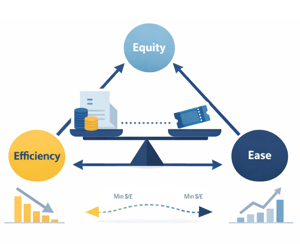
Per Kessler, all marketplaces are attempting to address a specific trilemma: equity (Is it fair?), efficiency (Is it the best use of the resource?), and easy (Is it hard to participate?). It takes me back to the early years at True Tickets and the blockchain trilemma of security, scale, and decentralization (one where you could only achieve two of the three dimensions). “No marketplace rules can guarantee an allocation that is at once efficient, equitable, and easy,” observes Kessler.
Today, ticket resale marketplaces have prioritized ease and efficiency over equity for decades. The situation is further complicated by the primary sale of live event tickets being predicated on a first come, first served model. All that has resulted in perverse incentives that drive many of the frustrating outcomes we see in ticketing today.
One approach we’ve taken at True Tickets is building a ticket resale solution around a simple belief: ticket resale should exist to serve the ticket issuer as well as the real patrons whose plans change and not to reward speculative behavior.
The key to achieving that isn’t eliminating resale. It’s designing it better, starting with venue-defined pricing rules.
When Pricing Rules Are Missing, Markets Break
When resale markets lack pricing rules, anyone can list tickets at any price. That freedom, coupled with a first come first served initial race condition and marketplaces that prioritize ease and efficiency over equity, creates a predictable distortion:
- Professional resellers list tickets at inflated prices
- Real patrons whose plans change are pushed into a resale environment designed for arbitrage, not for people simply trying to recoup the cost of a ticket.
- Patrons who actually want to go are priced out until the very last minute
At True Tickets, we built PatronSafe™ Ticket Resale to address this specific distortion by introducing pricing rules that create a crucial distinction:
- The ticket issuer (e.g. event organizer) can allow patrons to list authorized tickets for resale (to include price parameters)
- Speculative sellers are forced to compete against those face-value listings
- Speculative sellers may attempt to circumvent venue-defined pricing rules, putting higher-margin resale at risk by violating ticket terms and conditions
That single design choice meaningfully shifts the entire marketplace dynamic.
True Tickets PatronSafe Ticket Resale creates more equitable and efficient marketplaces, by shifting friction away from real patrons and toward speculative resale. Another critical benefit is that authorized resale maintains a verifiable record of each handoff, so venues don’t lose sight of who is actually attending, even when tickets are shared and resold multiple times, with each person who receives the ticket added to the CRM. Rather than vanishing into opaque secondary channels, new buyers remain visible to the venue.
A Real-World Example: John Oliver at The Fenway
My wife and I are John Oliver fans. When we found out (the week of) that he was performing at MGM Music Hall at Fenway on Saturday, December 27th and Sunday, December 28th, we immediately looked for tickets.
On the primary site, there were only a handful of single seats available, priced between $120 and $180 for Saturday night and Sunday night was sold out. We even spotted two singles in the same row about ten seats apart, but asking strangers to shuffle seats felt like more hassle than it was worth. Obviously, we had already lost in the first come, first served world of ticketing.
So we turned to the secondary market (I checked out all the marketplaces you know and a few you probably don’t).
For both shows, pairs of tickets started at $330+ (essentially 2–3x face value . . . to start). While we were absolutely willing to spend $240 to $360 to attend, $660 for a pair felt egregious.
What was missing wasn’t demand. It was a better-designed resale market.
What a Face-Value Cap Could Have Changed
If the MGM Music Hall at Fenway implemented a face-value resale option (where patrons who couldn’t attend could easily list tickets at face value) those tickets would have entered the market at roughly 25–40% above face once marketplace fees were applied (that’s typically what we’ve seen with our PatronSafe Ticket Resale clients—yes, it’s a premium, however, not 2x to 3x . . .again, to start!).
Instead of $330+ being the starting point, the secondary market would likely have formed a reasonable price band starting between $150 and $250.
We watched prices closely. On the day of each show, resale prices dropped back into the $180–$240 range. But by then, it was too late. With a 7-year-old at home, same-day planning isn’t realistic.
The likely outcome? Empty seats, missed connections with real patrons, chargebacks from speculative buyers, and no usable data on who actually wanted to attend.
What PatronSafe Ticket Resale Delivers
By allowing patrons to resell tickets with pricing rules enabled by PatronSafe Ticket Resale, venues drive ticket resale marketplaces to more equitable and efficient outcomes: lower volatility in resale pricing, higher conversion earlier in the lifecycle, fill more seats, and capture clean, first-party data.
As more venues experiment with pricing parameters, the resale market has an opportunity to evolve from a speed-driven arbitrage system into one designed for real patrons.
.jpg?width=290&name=MATT%20(002).jpg)